
Beyond the Scale: Navigating BMI, Metabolic Health, and Weight Management
The BMI Illusion
The Body Mass Index (BMI) was created in the 19th century by a mathematician, not a physician, to assess the collective weight of populations, not individual health. Today, it remains a widely used, yet fundamentally flawed, diagnostic tool.
BMI simply calculates weight relative to height. It cannot distinguish between bone density, muscle mass, and adipose tissue (fat). Consequently, a heavily muscled athlete may be categorized as “obese,” while an individual with low muscle mass but high visceral fat (fat stored deep inside the belly, wrapped around the organs) may be categorized as “normal weight.”
True Markers of Metabolic Health
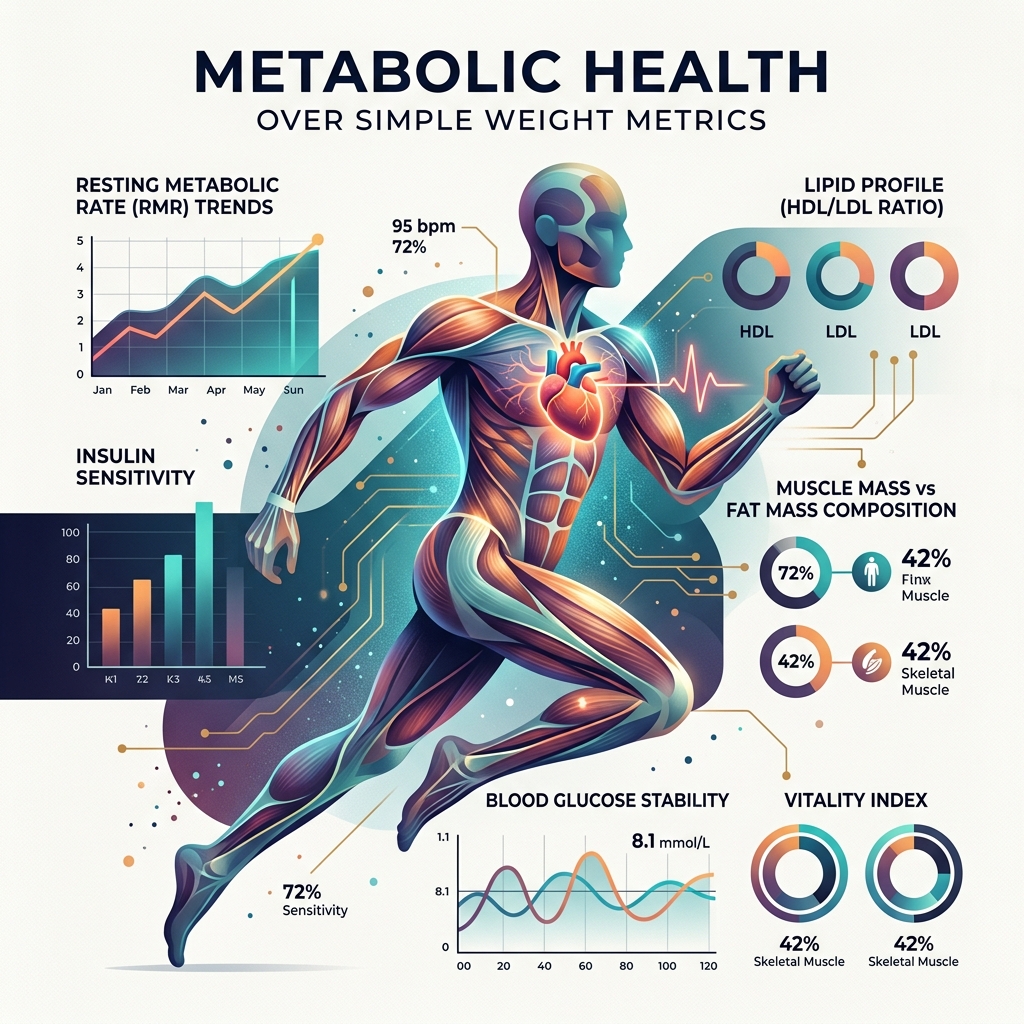
Rather than obsessing over the scale, modern medical analytics focus on metabolic markers that dictate cardiovascular risk, insulin sensitivity, and longevity.
- Visceral Adiposity: Measured via waist circumference or advanced DEXA scans. Visceral fat is biologically active, secreting inflammatory cytokines that drive heart disease.
- Fasting Insulin and HbA1c: These metrics track how efficiently your body manages glucose. Chronically elevated insulin prevents the body from utilizing stored fat for energy.
- Triglyceride-to-HDL Ratio: A highly predictive marker of cardiovascular health, far more informative than total cholesterol.
Strategic Weight Management
Sustainable weight management is rarely achieved through severe caloric restriction, which predictably tanks the basal metabolic rate (BMR). Instead, it requires metabolic flexibility—the body’s ability to efficiently switch between burning carbohydrates and fats.
- Protein Prioritization: A high-protein diet (0.8g - 1g per pound of ideal body weight) preserves lean muscle mass during fat loss, stabilizing the BMR and increasing satiety.
- Resistance Training over Chronic Cardio: Muscle is metabolically expensive tissue. Increasing muscle mass permanently elevates the baseline caloric burn rate.
The Desk’s Take: Editorial Insight
By the Medical Intelligence Unit
The global fixation on BMI and sheer weight loss has created a massive, highly profitable cycle of yo-yo dieting. “Skinny fat” (normal weight obesity) is an increasingly common and dangerous phenotype. The narrative must shift from “losing weight” to “recomping”—losing adipose tissue while aggressively building lean muscle. Until medical practitioners transition from relying on outdated 19th-century math to utilizing comprehensive metabolic panels, millions of patients will remain misdiagnosed regarding their actual cardiovascular risks.